

There’s a lot to learn about the Lighthouse at Cape Lookout National Seashore.
Here’s a timeline that traces key dates in the history of this magnificent structure:
1812
The first Cape Lookout Lighthouse comes online.
1851
Seafarers complained that a taller, more stable lighthouse is needed. Though attempts are made to renovate the first Cape Lookout Lighthouse, eventually the decision would be made to replace the outmoded structure.
1859
In 1857, Congress appropriated the funds to build a new lighthouse at Cape Lookout, and in 1859, the structure that you see today was completed and lighted.
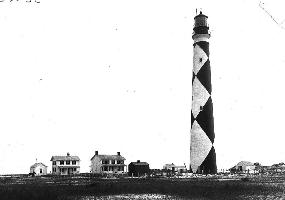 Photo, taken in 1913, of the second Cape Lookout lighthouse. -NPS
1863
The whale oil used to fuel the light climbed to $2.43 per gallon, prompting the Lighthouse Board to search for a cheaper alternative.
1864
A small group of Confederate troops attempted (unsuccessfully) to blow up the Lighthouse, which had come under control of Union forces during the Civil War.
1867
The original first-order Fresnel lens, which had been removed during the war and moved to Raleigh for safekeeping, is reinstalled.
1873
1873 was a busy year at the Lighthouse:
- The new keeper’s quarters are completed, which stand today and house a museum.
- The Lighthouse is painted with its distinctive day marker: diagonal black-and-white checkers or diamonds, and thus the popular local nickname for the Lighthouse, “The Diamond Lady.”
- Mineral oil (what we call kerosene today) replaces whale oil as the fuel used to ignite the lamp.
1933
A radiobeacon and electric lighting equipment are installed, and the 75-millimeter incandescent oil vapor lamp is replaced with four, 250-watt T-14 electric lamps (bulbs). This increased the candlepower from 77,000 to 160,000, and ushered in the need for generators to supply electricity.
1950
The Lighthouse becomes automated; however, because diesel-powered generators powered the Lighthouse, an operator was still needed to maintain and repair the generators.
The light keepers residing at the Cape departed, and the nearby Cape Lookout Coast Guard Station added monitoring the lighthouse to its duties.
1975
The Fresnel lens is removed and replaced with two aerobeacons mounted back-to-back and set to turn a full revolution every 30 seconds. This new light pattern, which we still see today, delivers one “flash” every 15 seconds.
1982
The Cape Lookout Coast Guard Station was closed and its rescue duties taken over by Fort Macon Station. Also that year, construction of an electrical cable from Harker’s Island commenced, switching the Lighthouse to shore power. Today these cables are failing. The future power supply for the Lighthouse may be solar.
2003
The lighthouse tower and remaining lighthouse property transferred from the U.S. Coast Guard to the National Park Service in a public ceremony. Climbing is allowed only on a few Open House days.
July 15, 2010 (my birthday!)
With repairs complete and a safety inspection passed, the lighthouse opened to the public for regular climbs for the first time in its history.
Weather permitting, you can climb the Lighthouse when it is open for the summer season, Wednesday-Sunday. Tickets are available at the Visitor’s Center on Cape Lookout.
Adapted from the Lighthouse History Timeline published by the National Park Service, available at: https://www.nps.gov/calo/learn/historyculture/lhouse_timeline.htm.

 Summer at Cape Lookout